Physician information about the OncoSeek® test
General information for physicians
OncoSeek® is a machine learning algorithm that analyses the concentrations of selected protein tumour markers from a blood sample. The algorithm evaluates relationships between markers, age, and sex to generate a result.
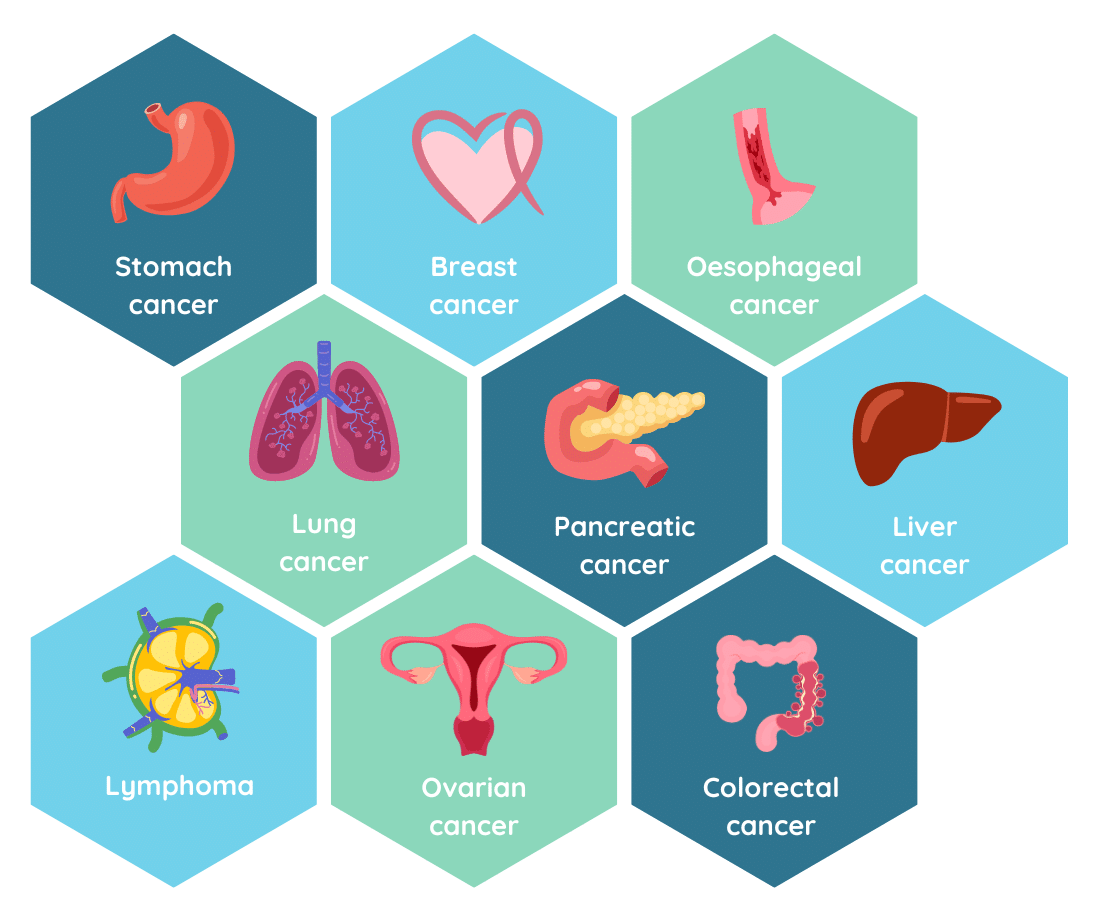
OncoSeek® detects nine high-mortality cancer types: breast, colorectal, oesophageal, liver, lung, lymphoma, ovarian, pancreatic, and stomach cancer.
OncoSeek® is intended for the quantitative detection of cancer signals from blood based on selected Protein Tumour Marker (PTM) quantification results using a machine learning algorithm. OncoSeek® is intended to complement, not replace, existing clinical cancer diagnostic pathways and tests. OncoSeek® is intended for adults with an elevated risk of cancer.
The OncoSeek® test
The six protein tumour markers analysed are AFP, CA125, CA15-3, CA19-9, CEA, and CYFRA21-1. The concentration levels of these markers are measured in a certified laboratory. The analysis results, together with age and sex, are used as input for the OncoSeek® algorithm to calculate a Probability of Cancer (PoC) score.
In cases of high probability, an indication of Tissue of Origin (ToO) is provided.
For whom is this test?
OncoSeek® is recommended for asymptomatic people with an elevated risk of cancer and for patients presenting with early cancer symptoms prior to referral to oncology. OncoSeek® has the strongest predictive performance in high-risk individuals and symptomatic patients.
Asymptomatic people with cancer risk factors
OncoSeek® may be considered for asymptomatic people with elevated cancer risk factors.
Patients with symptoms suggestive of cancer
OncoSeek® is intended to support referral decisions for further diagnostic evaluation of a specific cancer. The combination of symptoms and cancer risk factors in a patient may support consideration of OncoSeek®.
Symptoms related to any of the nine cancers included in OncoSeek® (breast, colorectal, oesophageal, liver, lung, lymphoma, ovarian, pancreatic, and stomach cancer) may support use of the test. Clinical judgment considering the patient’s overall situation remains essential.
Examples of symptoms may include, but are not limited to:
- Persistent night sweats or fever
- Fatigue
- Unexplained bleeding or bruising
- Unexplained pain or discomfort
- Unexplained weight loss
- Unusual lumps or swelling
- Persistent cough
- Breathlessness
- Persistent heartburn
- Loss of appetite

For whom is this test not recommended?
This test should not be used for:
- People who are pregnant
- People 21 years of age or younger
- Patients diagnosed with cancer who are undergoing active cancer treatment
- People who are unable to follow up on the results of the OncoSeek® test, including potential diagnostic procedures - and treatment

Benefits of using OncoSeek®
- Cancer may be detected earlier through the use of OncoSeek®. Although outcomes depend on the cancer type and clinical situation, earlier detection may improve patient outcomes.
- For symptomatic patients in primary care settings, OncoSeek® may serve as an additional clinical tool to support referral decisions.
- OncoSeek® is minimally invasive and requires only a blood draw.
- The test detects nine cancers simultaneously, including cancers for which population screening tests are currently limited or unavailable.
- This test may be repeated periodically to reassess cancer probability.

Risks and limitations of OncoSeek®
- OncoSeek® does not detect all cancers and should be used in addition to routine cancer screening tests and clinical evaluation.
- A blood draw is a common and generally safe procedure, but may lead to pain, bleeding, bruising, fainting, infection, and/or hematoma (blood clot under the skin) at the injection site.
- A positive result (Medium or High Probability) may cause anxiety or uncertainty.
- Following a positive result, confirmatory diagnostic procedures may not always be accessible to the patient. Logistic, financial, cultural, and geographic barriers may affect access to follow-up diagnostics and treatment. Access to confirmatory diagnostic services should be considered in advance together with the patient.
- False positive results may occur, potentially resulting in unnecessary diagnostic procedures with possible financial, physical, and psychological burden, as well as associated medical risks.
- False negative results may also occur, potentially resulting in false reassurance. Patients should continue routine medical follow-up and evaluation of symptoms.

References
- Luan, Y., Zhong, G., Li, S., Wu, W., Liu, X., Zhu, D., … & Mao, M. (2023). A panel of seven protein tumour markers for effective and affordable multi-cancer early detection by artificial intelligence: a large-scale and multicentre case–control study. EClinicalMedicine, 61.
- The Multicancer Early Detection Consortium Care Delivery Workgroup (2023). Multicancer Early Detection (MCED) Screening Guidance: A Recommended Care Pathway for Clinical Use of MCED Tests.
- Shen, Y., Xia, Y., Chang, Y., Xing, P., Li, S., Wu, W., ... & Mao, M. (2025). A large-scale, multi-centre validation study of an AI-empowered blood-based test for multi-cancer early detection. NPJ Precision Oncology, 9(1), 321.
Additional resources on MCD
Hanash, S. M., & Yu, P. P. (2024). Multicancer detection tests: What we know and what we don’t know. CA: A Cancer Journal for Clinicians.
Turning the tide of early cancer detection. (2024). Nat Med, 30, 1217.
Schrag, D., Beer, T. M., McDonnell, C. H., Nadauld, L., Dilaveri, C. A., Reid, R., … & Klein, E. A. (2023). Blood-based tests for multicancer early detection (PATHFINDER): a prospective cohort study. The Lancet, 402(10409), 1251–1260.
Contact us
For more information please contact us.