OncoSeek®
At OncoInv, we believe people deserve affordable and accessible cancer detection. When cancer is detected earlier, mortality and treatment burden can be reduced. Our goal is to support broader access to low-cost cancer detection worldwide through OncoSeek®.
How OncoSeek® works
OncoSeek® is a software-based blood test that uses a machine learning algorithm to detect nine high-mortality cancer types by analysing the concentrations of selected protein tumor markers.
The algorithm analyses the relationships between protein tumor markers and clinical factors, helping reduce false positives compared with conventional analysis of individually interpreted protein tumor markers.
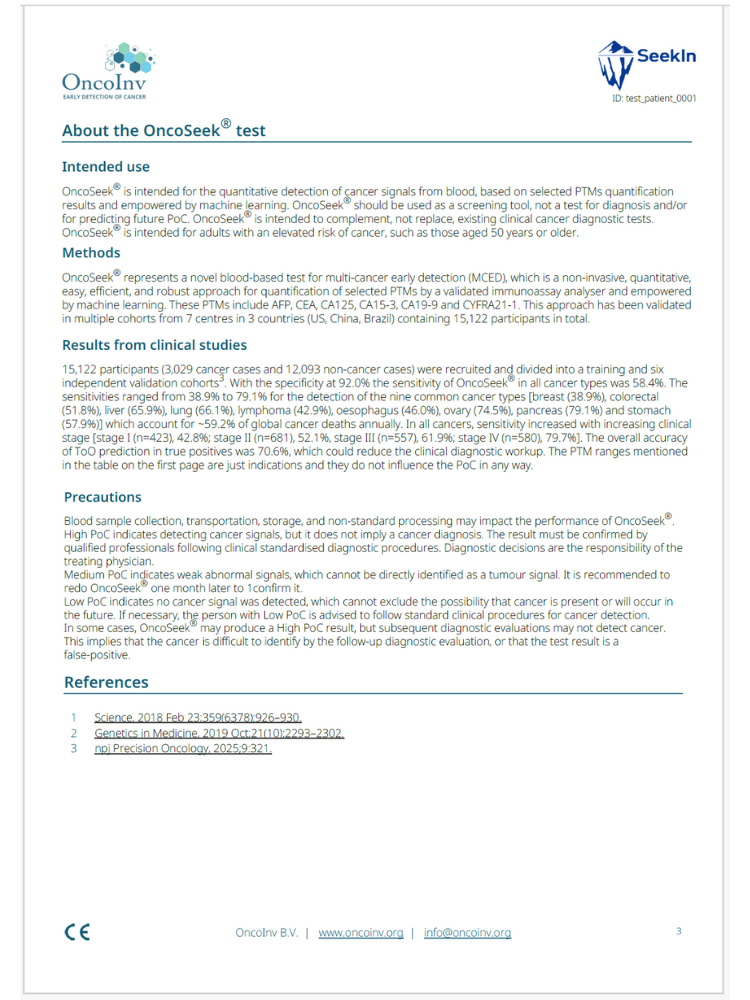
The average sensitivity is 58.4% (range: 38.9%–81.8%) with a specificity of 92.0%(1). The test also provides an indication of Tissue of Origin to help guide follow-up diagnostic steps.

Straightforward implementation
The laboratory analysis process is straightforward and can be performed on widely available analysis platforms using off-the-shelf reagents. The machine learning-based technology, combined with a standard laboratory workflow, enables a cost-effective and scalable solution.
OncoSeek® has been validated across multiple cohorts involving a total of 15,122 study participants.*
OncoSeek® is a CE-marked test and ISO 13485 certified.
Use cases
OncoSeek® is intended for symptomatic patients with suspicion of cancer in primary and ambulatory care settings.
OncoSeek® may also be used for at-risk populations through cancer screening, either as a standalone approach or complementary to existing screening programs.

The OncoSeek® process
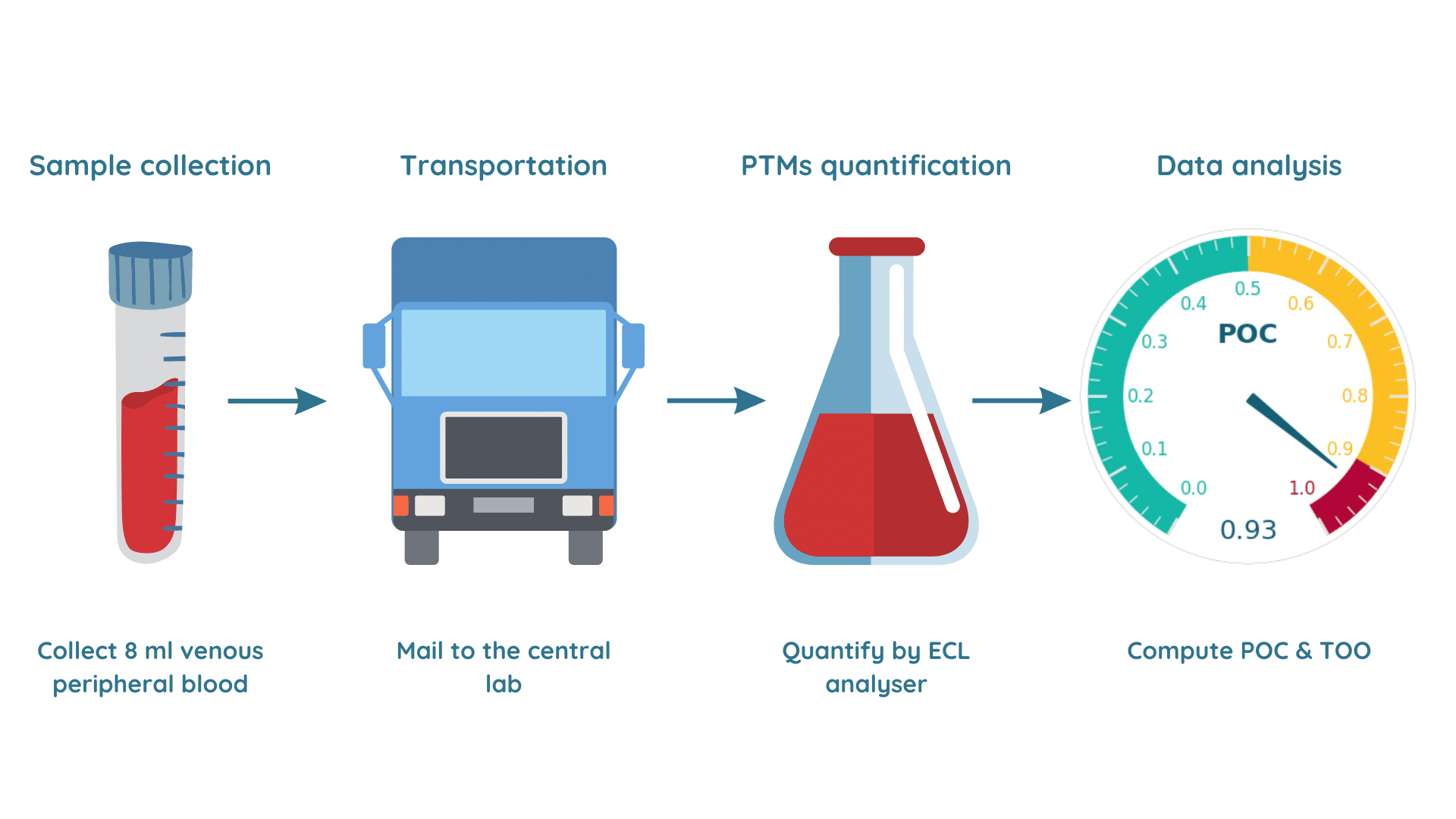
The OncoSeek® process is designed to integrate into existing healthcare settings. Blood collection can be performed by healthcare professionals using standard procedures. Samples are transported to a laboratory using locally available logistics solutions. When specific collection tubes are used, no special handling during transport is required.
A central laboratory uses a commonly available electrochemiluminescence platform to measure protein tumor marker values. These values are analysed by the machine learning algorithm, which runs in the cloud. Results are returned electronically to the treating healthcare professional.
Impact of multi-cancer detection

Reduces patient mortality

Reduces treatment burdern

Improves quality of life

Reduces healthcare cost
The facts
Clinical
Sample collection: 8 mL of venous blood collected by a medical professional.
Cancer types: Breast, colorectal, liver, lung, lymphoma, oesophageal, ovarian, pancreatic, and stomach cancer.
- Collectively accounting for approximately 59.2% of global cancer deaths.
- Includes cancers for which population screening programs are currently limited or unavailable.
Use cases:
- Patients with elevated cancer risk profiles and symptoms
- Primary and ambulatory care settings
- Screening of at-risk populations
Protein Tumour markers: AFP, CA125, CA15-3, CA19-9, CEA, and CYFRA 21-1.
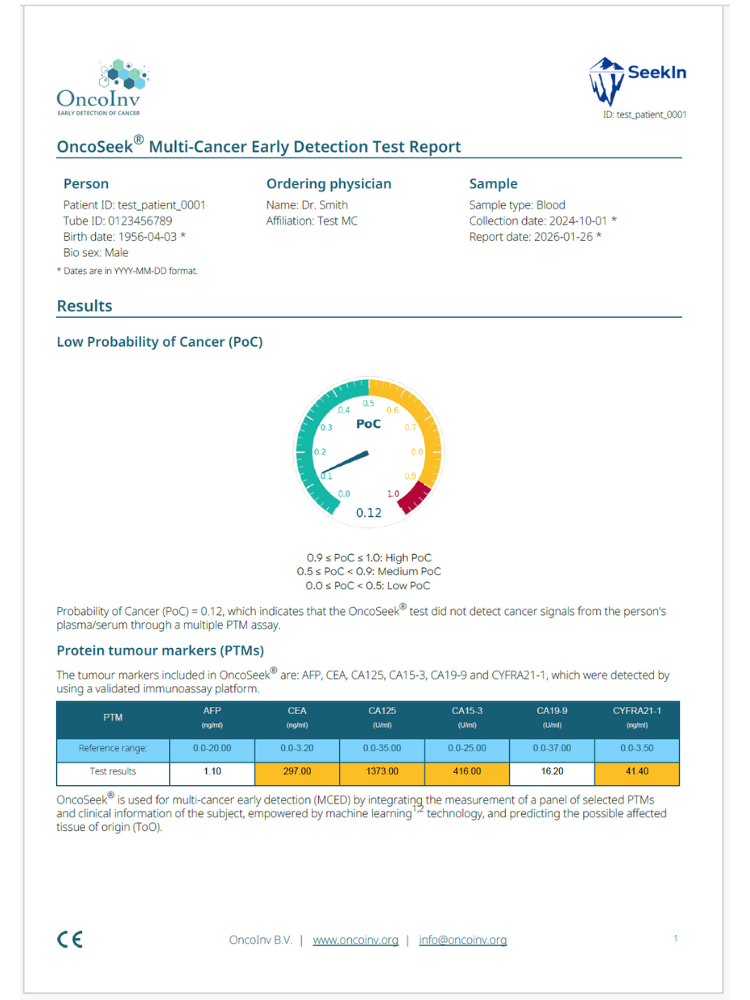
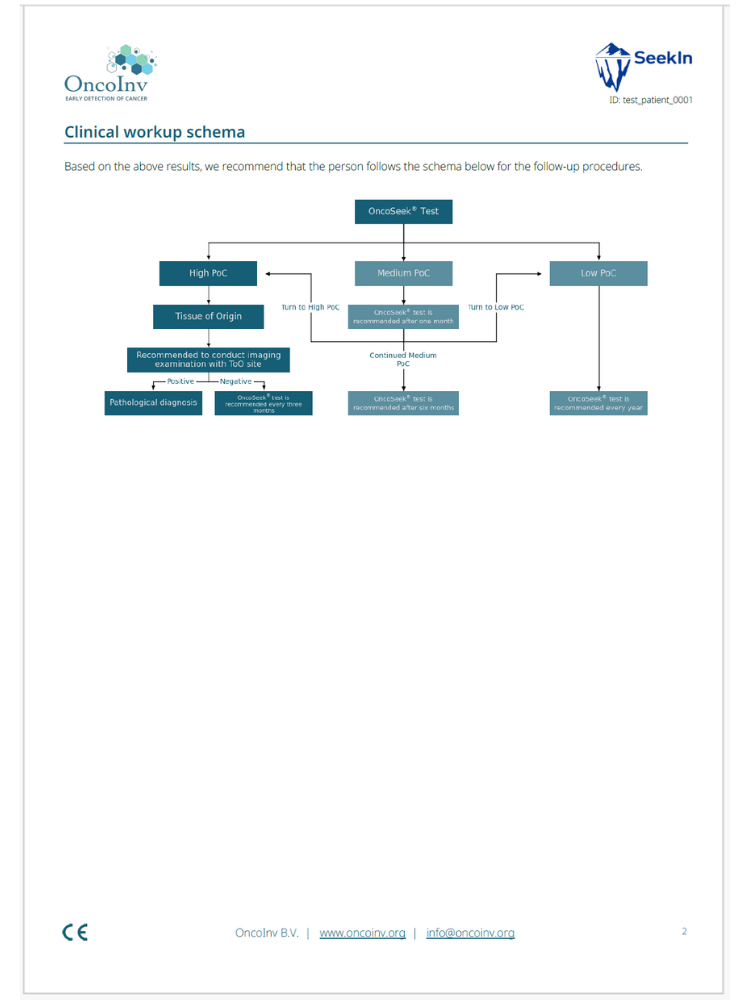
Test results: Results are communicated through low-, medium-, or high-risk scores. In cases of high risk, a predicted Tissue of Origin is provided. Results should be interpreted by a physician.
Performance*:
- Overall sensitivity: 58.4%
- Overall specificity: 92.0%
Concentration values are analysed using a machine learning algorithm that evaluates relationships between multiple markers.
Operational
Availability OncoSeek® can be provided as a full-service offering including laboratory analysis, or as algorithm-only deployment depending on local context.

Laboratory analysis Laboratory analysis in the EU is performed on Roche Cobas systems. Outside the EU, Roche Cobas, Abbott, GBI, BIO-Rad, or equivalent platforms may be used. Analysis uses off-the-shelf reagents that are widely available globally.

Algorithm analysis Algorithm analysis is cloud-based. Data is processed in the EU (Germany) in compliance with the EU General Data Protection Regulation (GDPR).

Service delivery Relevant patient and laboratory data are communicated to the platform, which generates and shares the report with the designated recipient.
Costs
- Low-cost test
- Initial studies on the cost-effectiveness of MCD tests have shown promising outcomes.*
- Not for profit in low- & middle-income countries
Factsheets
You can download our factsheet here:
Please note that our factsheet is for professional use for resellers and distributors only. We have an EU version and a global version for the rest of the world.
Case control study
Click here to access the large-scale, multi-centre case-control study.
Test results
The test results are communicated through low-, medium-, or high-risk scores. In cases of high risk, a predicted Tissue of Origin is provided. Results should be interpreted by a physician.