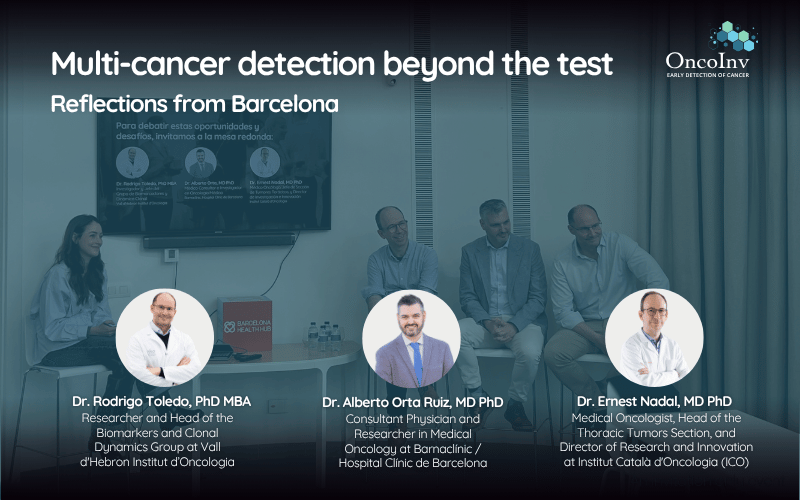
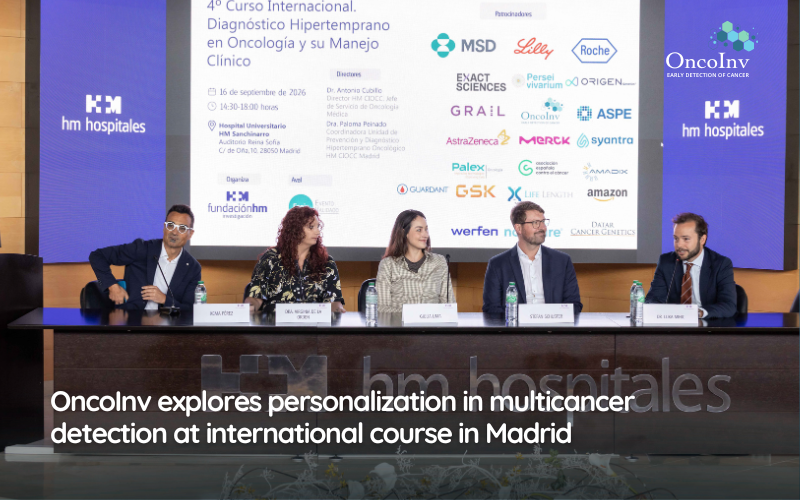
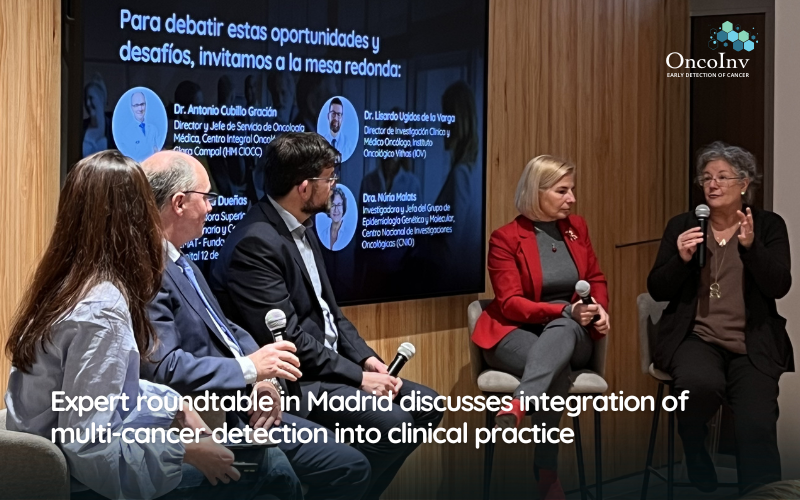
What does it take to move a promising technology from research into responsible clinical practice? That was a central question at OncoInv's expert meeting at Barcelona Health Hub, where oncologists, primary care physicians, internists and researchers came together for a high-level conversation about the state of multi-cancer detection (MCD).
The session opened with a review of the scientific landscape, from the biological principles behind liquid biopsy to the tests commercially available today and the major studies shaping the field. A key theme emerged early: the technology is advancing rapidly, but biological complexity sets real limits. As one participant noted, drawing on a phrase circulating in the field: "The hardest thing of all is to find a black cat in a dark room, especially when there is no cat." Detecting tumor-derived signals in blood, particularly at very early stages, remains an area of active scientific development and presents inherent challenges in terms of sensitivity.
The panel reflected on a broader tension the field is navigating. The most ambitious trials to date have generated results that spark important debate about how progress should be measured. Mortality reduction remains the ultimate benchmark, but demonstrating it requires long-term studies that are difficult to design and fund. Participants also noted that the interpretation of results is closely linked to study design, including scope and patient selection, which can significantly influence outcomes and comparability across trials. The criteria for evaluating these tests, and the bar for acting on existing data, remain active areas of discussion across the scientific community.
Alongside these considerations, the panel reinforced the importance of prevention and early detection, which remain underprioritized relative to treatment. One point raised: it is not necessary to wait for perfect evidence to act. The clinical rationale for detecting disease earlier has decades of support in other areas. What is needed is for the tool to work in practice, in a sustainable and equitable way.
On the question of implementation, the conversation was concrete. Participants converged on the view that MCD tests hold the greatest immediate value in well-defined higher-risk populations: individuals with relevant family history, carriers of germline mutations, or clinical scenarios where suspicion exists without localization. Broad use outside these contexts risks diluting clinical utility and increasing the burden of false positives on healthcare systems.
Structured care pathways were identified as a prerequisite, not an afterthought. A positive result requires a defined next step, including specialist access, confirmatory diagnostics and clear communication, and the infrastructure to support this does not yet exist at scale in most settings. Participants drew a parallel to the evolution of multidisciplinary treatment committees, suggesting that diagnostic committees may become similarly essential.
The roundtable concluded that the field is at an inflection point: scientifically promising, operationally complex, and in need of continued dialogue among clinicians, researchers, health systems and industry. This was the second gathering in OncoInv's ongoing expert series on MCD, with future sessions planned to deepen and broaden the conversation.